Imagine a material that is 200 times stronger than steel, yet also light, flexible, and stretchable. A material that conducts heat and electricity like no other—ideal for spacecraft that need to dissipate heat in the vacuum of space. That material is called graphene. Its strength, conductivity, UV resistance, and other properties make it desirable not only for space applications but across a wide range of industries. It could reduce CO2 emissions in concrete production and improve the stability and lifetime of batteries. Yet graphene has barely left the prototype stage, and global production remains miniscule.
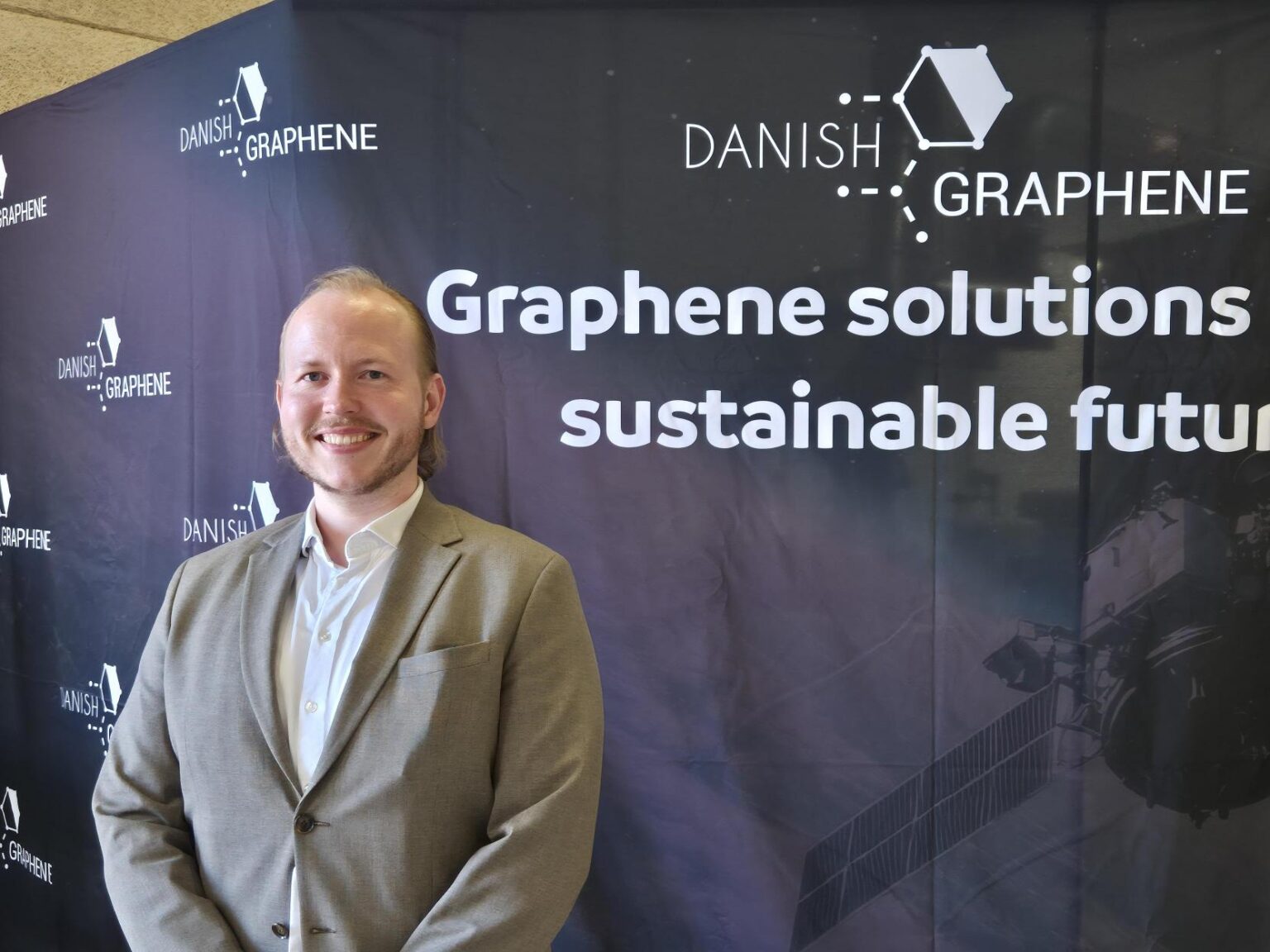
Danish Graphene works to change this. On 27 May, the startup unveiled its new 1,200 m2 production facility in southern Vejle.
“This enables the first large-scale production of graphene materials in Denmark and will make the facility one of the largest of its kind in Europe,” founder and CCO Andreas Brunsgaard Laursen tells Space Denmark.
Laursen started the company in 2020 based on his master’s thesis in nanoscience at Aarhus University. From graphene’s exceptional thermal transfer properties arose the idea of applying graphene materials to satellites to solve thermal issues in space. With no atmosphere to dissipate it, heat can easily build up and cause critical failures in a spacecraft’s electronics. In 2022, Danish Graphene joined ESA’s Business Incubation Centre in Denmark with the goal of developing a graphene-enhanced thermal interface material.
“There weren’t that many products for this. So we were like, how do we take the good conductive properties of graphene and introduce that into a setting, where it can be used for these applications. So we developed a thermal adhesive and launched that to the market in 2023, a year later,” Laursen explains.
Danish Graphene has pioneered an electrochemical process to manufacture graphene oxide – a derivative of pure graphene that retains most of the desired properties while also being easier to manufacture at scale. Graphene oxide is already being produced in large scale in China, Laursen points out, but in a way that is very chemical-intensive.
“Basically, you end up with 100 kilograms of chemical waste for every kilogram of graphene oxide produced,” he explains.
The electrochemical process that Danish Graphene is developing leaves only green hydrogen as a byproduct.
“That is really what we are introducing to the market and the industry: A more sustainable production, a more scalable system and a higher quality product that is more consistent, which is also needed for these large volume applications that we are looking at,” Laursen says.
Interest from Danish satellite manufacturers like Space Inventor and GomSpace helped Danish Graphene gain footing in the space market. Now, the company supplies the Finnish Earth observation company ICEYE with graphene materials and has made inroads with several large European companies, including Airbus, as well as American space companies like SpaceX, Intuitive Machines, Voyager Space and Axiom Space. Danish Graphene is also expanding its business into the automotive industry, data centers and battery technology.
“We’ve basically used space as a stamp of approval on the technology and the company to enter new industries. That’s how we’ve opened up the battery industry. Because, if we’re good enough for space, then we’re good enough for a lot of other applications,” Laursen says.
The company is, however, still rather small. It is made up of just 18 employees, though Laursen points out that they will start hiring more people later this year. But in order to truly grow, Danish Graphene needs to produce more graphene materials. Currently, the company produces about 50 kilograms of graphene oxide each year. With the company’s new facility, Danish Graphene will be able to produce around two tons every year.
“We’re basically proving that the technology can be scaled to this level before accelerating to hundreds of tons capacity to supply the growing demand in high-volume applications,” Laursen says.
He adds that his ambition is to reach a production capacity of around 300 tons a year within the next five years.