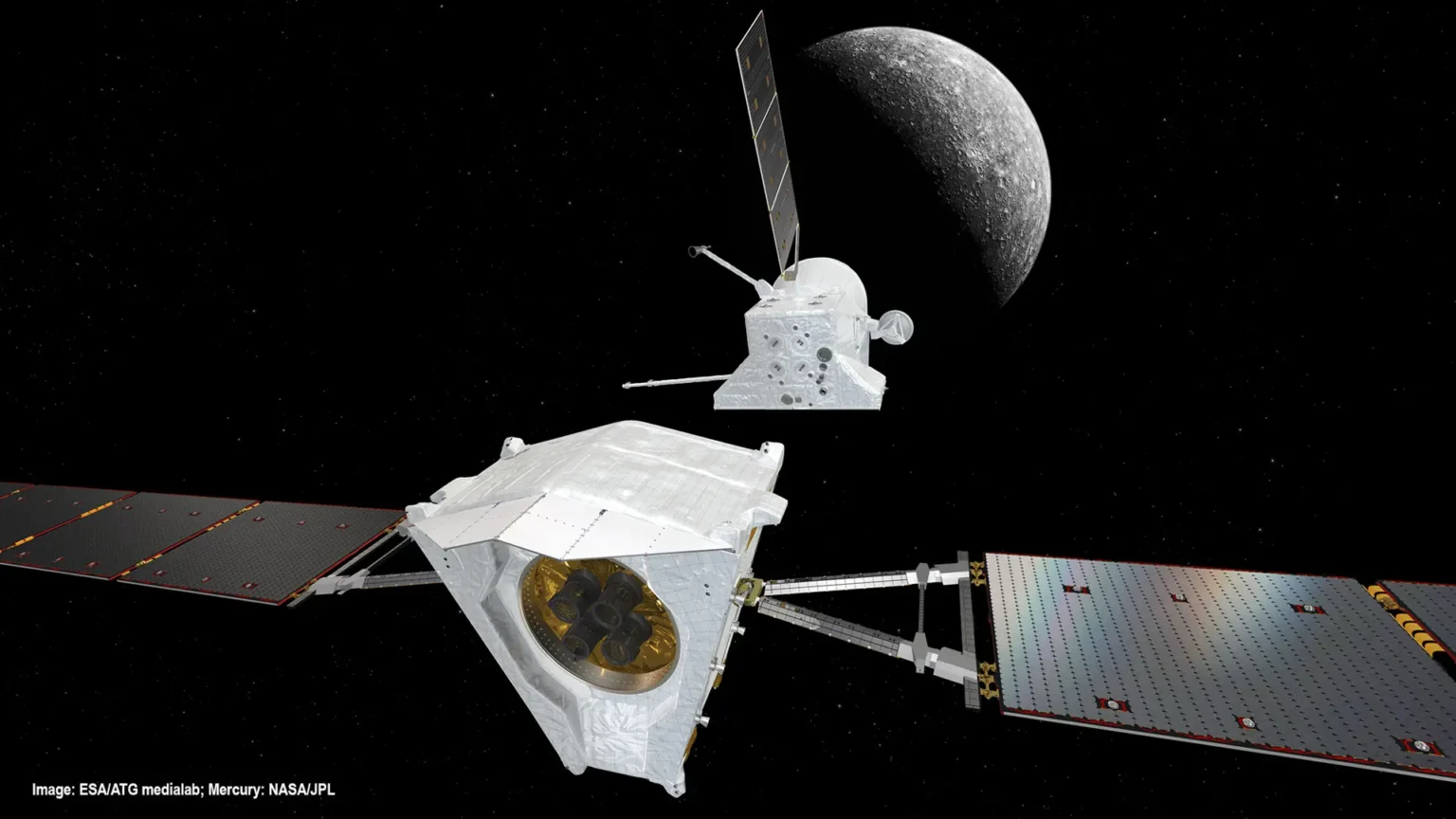
On 3 September, ESA’s BepiColombo mission to Mercury made an important preparation ahead of the mission’s arrival at the Solar System’s innermost planet on 21 November. The spacecraft separated from from the Mercury Transfor Module (MTM) – the module that has provided BepiColombo with power and solar electric propulsion on the cruise through the inner solar system over the last eight years.
The MTM was outfitted with a 20-kW Power Conditioning and Distribution Unit from Denmark’s largest aerospace and defence company, Terma. Up till the point of separation, it served to manage power from solar arrays and supply the spacecraft’s electric propulsion system and ESA’s Mercury Planetary Orbiter.
Before the launch, Terma also contributed to BepiColombo’s testing. The testing included things such as the Central Checkout System, Power and TT&C Checkout Equipment. Solutions that support the verification of the spacecraft’s subsystems, scientific instruments, power systems and radio-frequency systems, ensuring that everything runs smoothly.
Terma is part of the industrial team behind the Mission Control System used at ESA’s European Space Operations Centre in Darmstadt. The team contributed with mission-control support, system maintenance, simulations, flight dynamics and spacecraft operations, and paved the way for a successful Mercury in-orbit insertion. Terma specialists will continue to support the mission.
“BepiColombo demonstrates how reliability is built across the full mission lifecycle, from the development of the flight equipment and testing to mission control and operations. We are proud to support ESA and its partners as the mission approaches Mercury,” says Mats Warstedt, Senior Vice President, Space, Terma.
Also, when a power anomaly on BepiColombo was detected preventing the electric propulsion engines from operating at full thrust, Terma power specialists stepped in to play a key role within the joint ESA-industry response.
“A mission of this duration and complexity depends on reliable systems, thorough verification and long-term operational support. Terma has contributed with exceptional technical expertise, persistence and close cooperation with ESA and the satellite prime contractor Airbus. Terma’s specialists made an extraordinary contribution to that effort, and was a key part in safeguarding the mission, when it ran into problems with the power,” says Jose Aroca Aliaga, Spacecraft Electrical Lead, European Space Agency.
Apart from Terma, Rovsing, a supplier of ground test equipment and systems, provided validation of the software onboard BepiColombo. A Danish researcher is also affiliated with the mission: Senior Researcher Emerita Susanne Vennerstrøm at DTU serves as a member of the MPO-MAG science/instrument team for the mission.