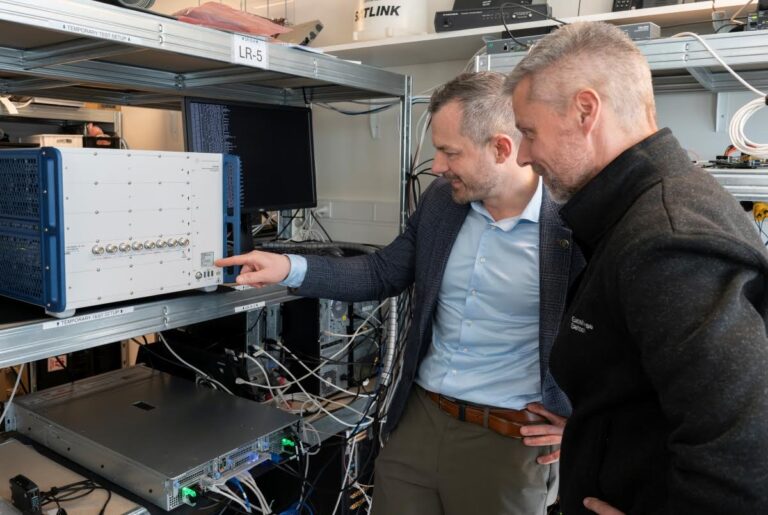
In Glostrup, Denmark, about 30 engineers make up Rovsing A/S, a technology company founded in 1992. They develop, produce and deliver test and simulation systems (EGSE) for satellites. Though small, the company has big customers and an even bigger impact on the space industry.
The Orion spacecraft that flew NASA’s astronauts around the Moon in April was powered by solar panels on the European Service Module, which had undergone testing using Rovsing’s SAW FEE hardware. Aside from delivering to NASA and ESA, Rovsing’s customers include big space primes like Boeing, Airbus, and Thales Alenia, as well as new-space companies such as The Exploration Company and Astroscale.
The company, however, has not done well with its financials recently. One of Rovsing’s board members and a major shareholder, Christian Klarskov, made that clear during a presentation of the Q3 results for the financial year 2025/2026 on 5 May.
“Rovsing has not earned the money it should have. There have been losses over the last four to five years. Naturally, that is not satisfactory as a shareholder,” Klarskov remarked.
Effects of Increased Space Budgets Already Being felt
Ahead of the presentation, Rovsing published its numbers for Q3: 9.2 million DKK in revenue and EBITDA of around 0. The guidance for the financial year 2025/2026 lies at 33-37 million DKK in revenue and EBITDA of between -2.5 and 0.5 million DKK. But as CFO Sigurd Hundrup – who spoke instead of CEO Hjalti Pall Thorvardarson since Thorvardarson will leave the company by the end of May – noted during the presentation, the company expects to hit the low end of those intervals.
Despite this, both Hundrup and Klarskov expressed optimism about Rovsing’s future. Not least because of the recent increases in European space budgets. As Hundrup pointed out, ESA has increased its budget by 32 per cent over the next three years, while Denmark is going to triple its investments in space over the same period. The effects are already felt in the company.
“What we can see is continued high tender activity. It has been increasing for many months now. We currently have outstanding proposals worth approximately 140 million DKK, which is a relatively high amount. This is of course a consequence of the new ESA budgets gradually being rolled out, and some of the missions we have bid on are a result of the new budgets that ESA has allocated,” Hundrup said.
He added that Rovsing typically wins about 20-30 per cent of the contracts the company bids on. The company’s order backlog currently amounts to 25.9 million DKK.
Rovsing “Too Nice” to its Customers
Hundrup emphasised Denmark’s increased investments in ESA, since the policy of geo-return means those investments will eventually benefit Danish contractors. He also pointed out that the EU equally has increased its investments in space, notably with the planned IRIS² constellation, which Rovsing has bid on.
The increased European tender activity combined with Rovsing’s financial challenges has prompted the company to initiate a fully guaranteed rights issue intended to raise 10 million DKK. In Rovsing’s announcement of the fully guaranteed rights issue, it says that the proceeds will be used to strengthen the company’s capital structure and financial flexibility.
“A strong capital structure is a prerequisite for winning contracts with large customers and space agencies, who require key suppliers to be financially robust for the duration of space missions,” it continues.
Rovsing’s capital structure was one of the things that Klarskov remarked on during the Q3 presentation.
“It has been too thin. There are some concrete examples where some of our good customers have called us and asked if we could deliver quickly. There have been cases where we simply couldn’t deliver because we didn’t have enough in stock. That really pains me – both as a board member and as a shareholder.”
According to Klarskov, one explanation for Rovsing’s financial challenges has been that the company has been “too nice to its customers” and not billed them sufficiently, when they have come up with changes to their orders. He added, though, that the company has many qualities that bode well for the future.
“Rovsing has a strong moat. We have the right customers. We have the right products. In addition, the market growth stemming from rising ESA budgets and new private space companies will create a topline effect which, with the gross margin we operate with, will flow through to the bottom line.”